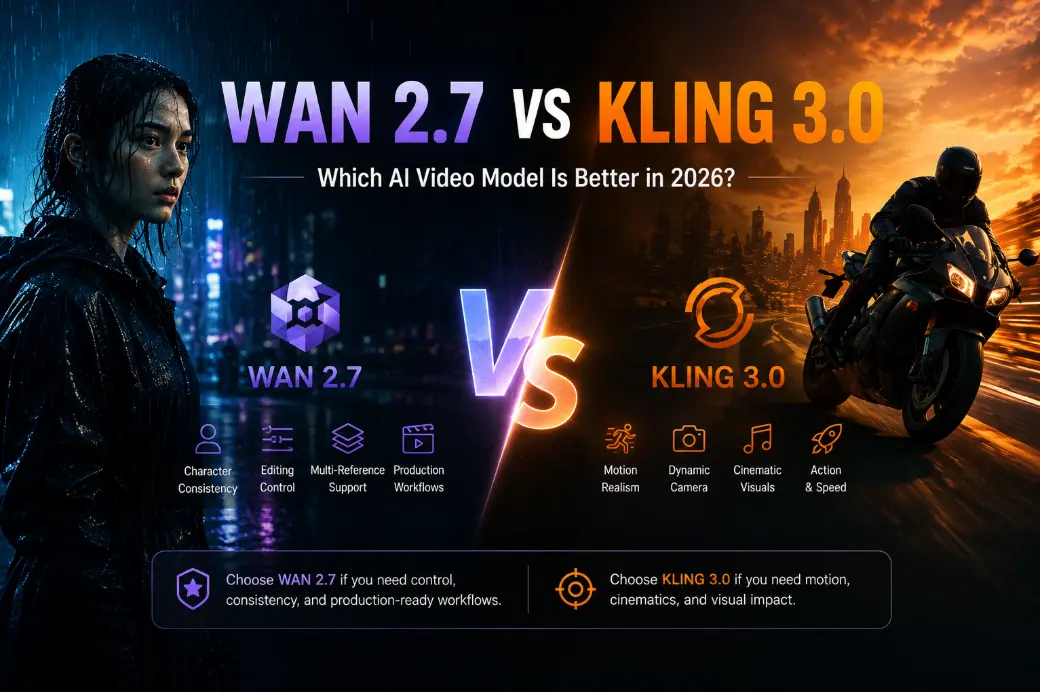
AI video generation has entered a new era.
Today, creators, marketers, filmmakers, and AI startups are no longer asking whether AI can generate high-quality videos. The real question is:
Should you use Wan 2.7 or Kling 3.0?
Both models are among the most powerful AI video generation systems available in 2026. They can create cinematic footage, realistic motion, and visually stunning scenes. However, they are designed for very different workflows.
Kling 3.0 focuses on cinematic motion, camera movement, and visual realism.
Wan 2.7 focuses on controllability, character consistency, reference-based generation, and production-ready workflows.
If you're building AI short films, commercial advertisements, branded storytelling, or an AI video SaaS product, understanding the differences can save countless hours of production time.
Quick Comparison
Feature | Wan 2.7 | Kling 3.0 |
|---|---|---|
Developer | Alibaba Tongyi Lab | Kuaishou |
Native Resolution | 1080P | 1080P |
Character Consistency | Excellent | Very Good |
Motion Realism | Very Good | Excellent |
Camera Movement | Good | Excellent |
Start-End Frame Control | Yes | No |
Multi-Reference Support | Up to 5 References | Limited |
9-Grid Reference Input | Yes | No |
Motion Transfer | Good | Best-in-Class |
Instruction-Based Editing | Yes | Limited |
Storytelling Workflows | Excellent | Good |
Commercial Production | Excellent | Very Good |
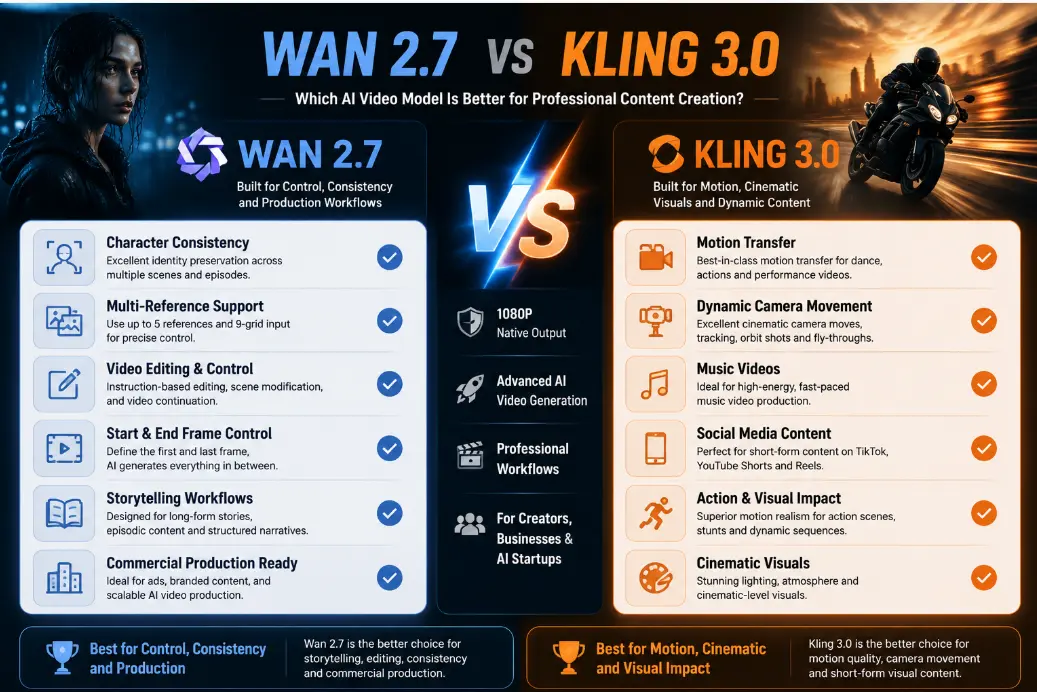
At a glance:
Kling 3.0 excels in motion realism and cinematic presentation.
Wan 2.7 excels in control, consistency, and production workflows.
Character Consistency
One of the biggest challenges in AI video generation is maintaining the same character across multiple scenes.
Many video models generate impressive first shots, but faces, clothing, hairstyles, and identities gradually drift throughout longer sequences.
Wan 2.7 was specifically designed to address this problem.
Key capabilities include:
Multi-reference character generation
Identity preservation
Up to five references
Real-person references
Multi-scene consistency
Story-driven generation
Example
Imagine producing a three-part detective series.
Episode 1:
Walking through a rainy city.
Episode 2:
Driving a car at night.
Episode 3:
Investigating a crime scene.
With Wan 2.7, the same character can remain visually consistent across all three episodes.
For long-form storytelling, this is often more important than raw visual quality.
Motion Quality
Kling 3.0 currently leads in motion realism.
The model is known for:
Better body dynamics
More realistic inertia
Improved object interaction
Natural camera tracking
Better physical simulation
Example
Prompt:
"A woman runs through a crowded market while the camera follows from behind."
Kling 3.0 generally produces:
Better foot contact
More realistic body weight
Better clothing motion
More believable movement physics
The resulting footage often feels closer to real cinematography.
Editing and Controllability
This is where Wan 2.7 becomes extremely powerful.
Wan 2.7 supports:
Instruction-based editing
Reference-based editing
Video continuation
Character preservation
Multi-image generation
Scene modification
Instead of generating an entirely new clip, creators can modify existing footage while maintaining consistency.
Example
Original clip:
A woman standing.
Instruction:
"Make her walk toward the camera and smile."
Wan 2.7 can preserve the character while changing only the requested action.
This dramatically reduces production costs for marketing teams and creators.
Start and End Frame Control
One of Wan 2.7's most valuable capabilities is first-frame and last-frame control.
Creators can define:
Starting frame
Ending frame
The model automatically generates everything in between.
Example
Frame 1:
A character standing beside a motorcycle.
Frame 120:
The same character riding away into the sunset.
Wan 2.7 automatically generates the transition.
This gives creators significantly more storytelling control than traditional prompt-only video generation.
Wan 2.7 Visual Quality Demo
What This Demo Shows
The video above demonstrates why Wan 2.7 has become a popular choice for professional AI video production.
Key strengths include:
Rich environmental storytelling
Cinematic lighting
Smooth motion generation
Strong scene-to-scene consistency
High-quality visual composition
The sequence transitions through underwater ecosystems, jellyfish fluid motion, aurora landscapes, atmospheric effects, and fireworks scenes while maintaining stable visual quality throughout.
Unlike many AI video models that struggle when switching between dramatically different environments, Wan 2.7 preserves visual coherence and cinematic aesthetics across the entire sequence.
These capabilities are especially valuable for:
AI advertisements
Brand campaigns
Product marketing videos
YouTube content creation
Educational storytelling
Long-form narrative projects
For creators who need both visual quality and production control, Wan 2.7 offers a workflow that is difficult to match with traditional prompt-only video generators.
Try Wan 2.7 Yourself
Want to create similar videos?
You can explore the complete Wan 2.7 workflow through WanOmni , an all-in-one AI creation platform that supports:
Text to Video
Image to Video
Reference to Video
Video Editing
Character Consistency
First & Last Frame Control
Multi-Shot Storytelling
Native 1080P Output
This makes it one of the most practical ways to experience the capabilities discussed throughout this comparison.
Multi-Reference Workflows
Wan 2.7 supports workflows that are difficult to achieve with most AI video generators.
Features include:
Up to five references
Multi-character consistency
Reference-guided generation
9-grid reference input
Scene continuity
This makes Wan 2.7 ideal for:
Product marketing
Brand campaigns
Character-driven stories
Commercial production
Educational content
Rather than generating isolated clips, Wan behaves more like a complete production system.
Resolution and Output Quality
Resolution | Wan 2.7 | Kling 3.0 |
|---|---|---|
720P | Yes | Yes |
1080P | Native | Native |
4K Workflow | Limited | Better |
HDR Support | Limited | Better |
Professional Pipeline | Good | Excellent |
Both models deliver excellent 1080P output.
Kling generally performs better for high-end cinematic visuals and advanced camera movement.
Wan performs better for structured content production.
When Should You Choose Wan 2.7?
Wan 2.7 is the better choice when your project requires:
AI Short Dramas
Maintaining the same characters across multiple episodes.
AI Commercials
Keeping products and branding consistent.
Character Storytelling
Creating recurring characters and narrative content.
AI SaaS Products
Building:
AI Video Generators
AI Ad Creators
AI Storytelling Platforms
AI Character Studios
Educational Content
Producing predictable visual narratives.
Kling 3.0 Still Has Advantages in Certain Scenarios
While Wan 2.7 offers stronger control, character consistency, and production workflows, Kling 3.0 still has clear advantages in certain areas.
For creators whose primary goal is cinematic motion, dynamic camera movement, and visually striking content, Kling 3.0 remains one of the strongest AI video generation models available today.
Dynamic Camera Movement
Kling 3.0 excels at creating complex camera movements, including tracking shots, cinematic fly-throughs, orbit shots, and dramatic perspective changes.
For projects that rely heavily on camera motion to create visual impact, Kling often produces more dynamic results.
Motion Transfer
Kling is particularly strong in motion transfer workflows.
Creators can apply dance performances, action sequences, and character movements from reference videos to entirely different characters while preserving natural body motion.
This makes Kling especially useful for animation, virtual influencers, and performance-based content.
Music Videos
Music videos often require fast-paced editing, energetic motion, and visually engaging scenes.
Kling 3.0 performs exceptionally well in these scenarios thanks to its strong motion generation capabilities and cinematic visual style.
Social Media Content
For short-form content on platforms such as TikTok, YouTube Shorts, and Instagram Reels, visual impact is often more important than long-term character consistency.
Kling's ability to generate eye-catching motion and dramatic camera movement makes it well-suited for viral-style content creation.
Experimental Visual Projects
Artists and creative studios often use Kling for experimental projects that emphasize style, movement, and visual exploration.
Its cinematic approach allows creators to produce highly stylized scenes with strong visual appeal.
The Trade-Off
The choice between Wan 2.7 and Kling 3.0 ultimately depends on the type of content being produced.
If the priority is motion quality, camera movement, and cinematic visuals, Kling 3.0 remains an excellent choice.
However, for character consistency, video editing, multi-reference generation, structured storytelling, and scalable commercial production, Wan 2.7 generally provides a more complete and production-ready workflow.
For most businesses, agencies, SaaS builders, and long-form content creators, these workflow advantages often make Wan 2.7 the more practical solution for real-world production.
Real Production Scenario
Imagine creating a 30-second commercial.
Wan 2.7 Workflow
Upload product references
Upload character references
Define first frame
Define last frame
Generate scenes
Edit scenes using instructions
Result:
Consistent branding
Consistent characters
Predictable outputs
Easier revisions
Kling 3.0 Workflow
Generate hero shots
Apply motion control
Add cinematic camera movement
Produce visually stunning sequences
Result:
More visually impressive
Less production control
Final Verdict
Choose Wan 2.7 if you need:
✅ Character consistency
✅ Storytelling
✅ Multi-reference generation
✅ AI advertisements
✅ Branded content
✅ Commercial production
✅ AI SaaS products
✅ Controlled editing workflows
✅ First and last frame control
Choose Kling 3.0 if you need:
✅ Best motion quality
✅ Dynamic camera movement
✅ Motion transfer
✅ Dance generation
✅ Music videos
✅ Viral social content
✅ Cinematic visuals
Conclusion
Kling 3.0 may be the stronger pure video generation model.
However, Wan 2.7 is often the better production platform.
For agencies, marketers, content studios, SaaS builders, and creators who need reliable, repeatable, and controllable outputs, Wan 2.7 offers a workflow that is much closer to professional video production.
If your goal is long-form storytelling, character consistency, commercial content, or scalable AI video generation, Wan 2.7 remains one of the strongest choices available in 2026.